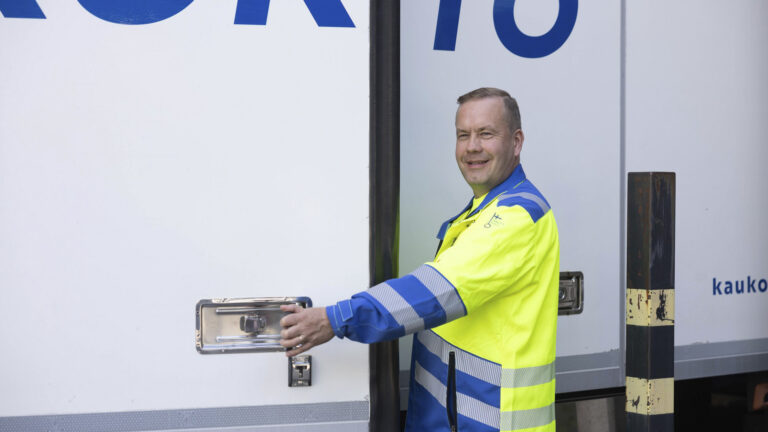
Drivers form the largest employee group in the Kaukokiito network. There are 1,300 drivers on the transport operators’ payrolls and several hundred more through subcontracting.
In people’s minds, the stereotypical HGV driver is often a middle-aged man dressed in jeans, a T-shirt, and a cap, with clogs on his feet. He may have a thick beard or moustache, often appearing rugged and tough to those around him.
The legendary trucker spends a lot of time on the road, so he’s used to long periods of solitude and his own routines. The cab of his truck may have a variety of decorations, such as teddy bears, flags and posters, to make the cab feel more like home. The diet of such legendary truckers includes coffee, sausages, and a cigarette for dessert. Undoubtedly, these stereotypical “old-school” truckers have always been, and still are, hard-as-nails workers.
One of the main factors in employee retention has proven to be how effectively the employer and employee can plan shifts and tasks together throughout the career.
Hanna Vainio, Human Resources Manager, Kuljetusliike Taipale Oy
However, the modern driver often differs in many ways from the traditional, legendary old-school image. The average age of a driver in the Kaukokiito chain is around 40, and the number of female drivers is growing encouragingly each year. The number of different nationalities has also increased significantly over the past decade.
It’s also nice to see parental leave being taken more frequently every year. It’s equally great to see that companies are celebrating retirement. This goes to show that today, after long and full careers, even drivers can retire directly from the profession, without the need to switch industries as you get older. This longevity is supported by advancements in working methods, conditions, technology, and equipment: there’s greater emphasis placed on ergonomics and safety issues; shift patterns are more humane thanks to driving and rest time regulations; and vehicles have more driver-friendly technology. Also, load-handling equipment has transitioned to using electric and gas power. These are just a few examples of the changes witnessed over the decades, though we must remember that the transport sector is very diverse, and not all roles in this sector are on a level playing field.
Where does (occupational) well-being start?
Employee well-being starts with the individual; only after that can the employer provide the necessary tools to support it. The well-being of a driver, like all employees, starts with the right fundamentals: skills that match the work tasks, adequate training for new or changing tasks, and equipment, tools, and clothing that suit the purpose. It also requires professional leadership, clear communication and guidelines, clear and achievable goals, and a healthy work-life balance.
There are legendary stories of the trucker who left home on a Sunday evening and returned home three weeks later in time for a Saturday to take a sauna. Traditionally, the spouse looked after the home and the offspring. Today, a major factor in employee retention is how effectively the employer and employee can plan shifts and tasks together over the course of the driver’s career. Situations in life and family dynamics change: sometimes you can travel and spend several days away from home, but at other times your circumstances require you to get home in the afternoon to pick up your children from daycare, for example.
Sometimes health issues arise, and then, alongside functional occupational healthcare, the employer also has the chance of modifying or reducing tasks to ensure a career can continue with the same company. Of course, it is clear that an employer cannot be flexible in every situation, but with constructive cooperation, a surprising number of solutions is available.
Despite modern aids, loading and unloading general cargo remains a physical challenge compared to e.g. transporting extractable land resources. At customer sites, equipment for lifting shipments of several hundred kilograms is not always available; instead, they need to be unloaded using manual strength and a pallet truck. To compensate for the long periods of sitting in a cab, distribution drivers may climb in and out of the cab dozens of times each day. Taking care of oneself is always an individual responsibility: your employer can support, help and arrange various services, but they can’t do your grocery shopping or go to the gym on your behalf. Fortunately, we have a network-wide system of benefits, such as a fitness benefit, to help lower the threshold for doing exercise and staying active.
A healthy employee is motivated, productive and committed – a win-win situation that benefits most of all the employee and, of course, the entire organisation.